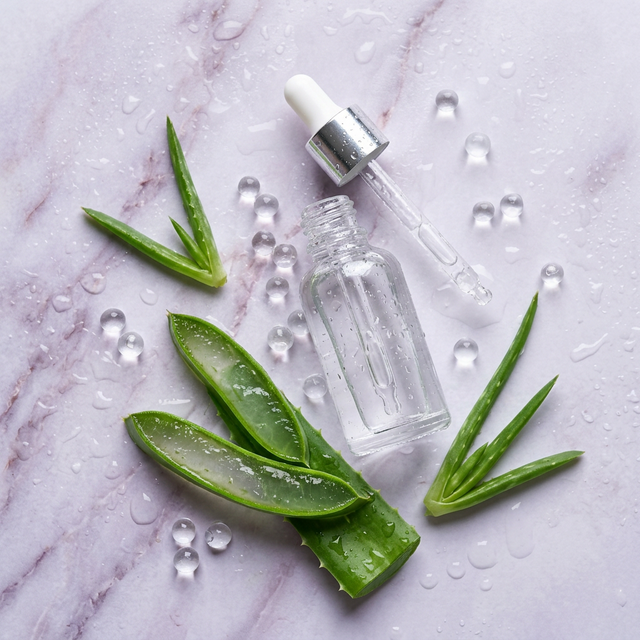
The Science Behind Hyaluronic Acid
If you've looked at any skincare product in the last decade, you've seen hyaluronic acid (HA) on the ingredient list. It's in serums, moisturisers, sheet masks, and even foundations. But what does it actually do, and is it worth the hype?
The short answer: yes. Here's the science.
What Is Hyaluronic Acid?
Hyaluronic acid is a glycosaminoglycan — a naturally occurring sugar molecule found throughout your body, with the highest concentrations in your skin, connective tissue, and eyes. About 50% of your body's total HA is in your skin.
Its superpower? A single molecule of hyaluronic acid can hold up to 1,000 times its weight in water. That makes it one of the most effective hydrating ingredients known to skincare science.
How It Works in Your Skin
HA works as a humectant — it draws water from the environment and deeper skin layers and holds it in the epidermis. This does several things:
- Plumps the skin — hydrated skin looks fuller and smoother, reducing the appearance of fine lines
- Strengthens the barrier — well-hydrated skin is more resilient to environmental damage
- Improves texture — consistent hydration leads to a smoother, more even complexion
- Supports healing — HA plays a role in tissue repair and wound healing
Molecular Weight Matters
Not all hyaluronic acid is created equal. The molecule comes in different sizes, measured by molecular weight, and each has a different effect:
High Molecular Weight (HMW) HA
Large molecules (1,000–1,800 kDa) that sit on the skin's surface, forming a hydrating film. They're excellent for immediate plumping and moisture retention but don't penetrate deeply. Most drugstore serums use this form.
Low Molecular Weight (LMW) HA
Smaller molecules (50–400 kDa) that can penetrate into the upper layers of the epidermis. They provide deeper, longer-lasting hydration from within. Premium serums often combine both HMW and LMW for maximum effect.
Sodium Hyaluronate
The salt form of HA, with an even smaller molecular size. It penetrates more easily and is more stable in formulations. You'll often see this on ingredient lists — it's essentially a more bioavailable form of HA.
DermLens AI Tip: Look for serums that list multiple molecular weights of HA, or that contain both "hyaluronic acid" and "sodium hyaluronate." This multi-weight approach provides hydration at every level of the skin.
How to Use Hyaluronic Acid Properly
Here's where most people go wrong. HA is a humectant — it draws water. But if you apply it to dry skin in a dry climate, it can actually pull moisture out of your skin instead of drawing it in.
The Golden Rules
- Apply to damp skin — mist your face with water or apply HA immediately after cleansing while skin is still wet
- Layer a moisturiser on top — this seals in the hydration and prevents evaporation (an occlusive like squalane or a cream with ceramides works well)
- Use 2–3 drops — more isn't better. A thin layer is all you need
- Apply morning and evening — HA is gentle enough for twice-daily use and works in any routine
Can You Overuse Hyaluronic Acid?
HA is extremely well-tolerated by virtually all skin types. It's non-irritating, non-comedogenic, and safe to use alongside actives like retinol, vitamin C, niacinamide, and AHAs/BHAs. There's no risk of over-exfoliation or sensitisation.
That said, if you live in a very dry climate (low humidity), be extra diligent about layering a heavier moisturiser over your HA serum. Without external moisture to draw from, HA in very dry air can paradoxically dehydrate the skin.
HA vs Other Hydrators
How does HA compare to other popular hydrating ingredients?
- Glycerin — another humectant, slightly tackier but equally effective. Often used in conjunction with HA
- Squalane — an emollient (not a humectant). It seals in moisture rather than attracting it. Use it over HA, not instead of it
- Ceramides — these repair the skin barrier itself. They work differently from HA but are complementary
- Aloe Vera — a mild humectant with soothing properties. Less potent than HA but great for sensitive skin
The Bottom Line
Hyaluronic acid isn't just a trend — it's a fundamental skincare ingredient backed by decades of dermatological research. It's suitable for every skin type, plays well with every other ingredient, and delivers visible results when used correctly.
The key is application technique: damp skin + HA + moisturiser seal = maximum hydration.
Related Articles
Want to know your skin's hydration level?
Get a free AI skin analysis and discover tailored product recommendations.
Try DermLens AI